
How to Introduce Dogs Safely at Home and Outside
A good dog introduction should look almost boring. There is no rush toward nose-to-nose contact, no tight leashes pulling two dogs together, and no assumption that a wagging tail means everything is fine. Learning how to introduce dogs safely means giving both dogs enough space, structure, and time to make calm choices.
That matters whether you are bringing home a new puppy, introducing dogs before a playdate, or trying to help two adult dogs share a household. Dogs do not need to become instant best friends. The first goal is simpler: each dog should feel safe, manageable, and able to disengage from the other dog without pressure.
Start With an Honest Read of Both Dogs
Before arranging a meeting, consider each dog's history and current behavior. A social, well-mannered dog may still become tense around a dog that crowds, stares, or ignores social signals. Likewise, a dog that barks or lunges on leash is not necessarily aggressive, but that dog does need a more controlled setup than a casual greeting outside a coffee shop.
Look at more than tail movement. Loose body posture, soft eyes, curved approaches, sniffing the ground, and the ability to look away are generally encouraging signs. Stiff legs, a closed mouth, hard staring, raised hackles, freezing, repeated lip licking, growling, or frantic pulling tell you to create more distance.
Do not punish a growl. A growl is useful communication that says a dog is uncomfortable. Correcting the warning without addressing the discomfort can teach a dog to skip the warning next time. Instead, calmly increase space and reassess the situation.
If either dog has a bite history, severe leash reactivity, guarding behavior, or unpredictable responses to other dogs, do not attempt a standard introduction on your own. Behavioral Therapy and a professional evaluation can provide a plan suited to the dogs in front of you.
Choose the Right Location and Equipment
First meetings usually go better on neutral ground. A quiet sidewalk, open green space, or low-traffic area gives both dogs room to move without one dog feeling that its home, yard, bed, or owner must be protected. Avoid dog parks for a first introduction. Too many dogs, distractions, and unknown handling styles make it harder to read behavior and intervene early.
Use a regular six-foot leash and a secure, properly fitted collar or harness. Retractable leashes are a poor choice because they create inconsistent distance and can leave handlers with little control when a dog suddenly rushes forward. Each dog should have a separate adult handler who can stay calm, move smoothly, and avoid adding tension through constant leash pressure.
Bring high-value treats if the dogs can eat around one another without becoming possessive. At the beginning, use treats to reward calm check-ins with the handler, relaxed walking, and choosing to disengage. Do not use food to lure dogs directly into each other's space.
How to Introduce Dogs Safely With Parallel Walks
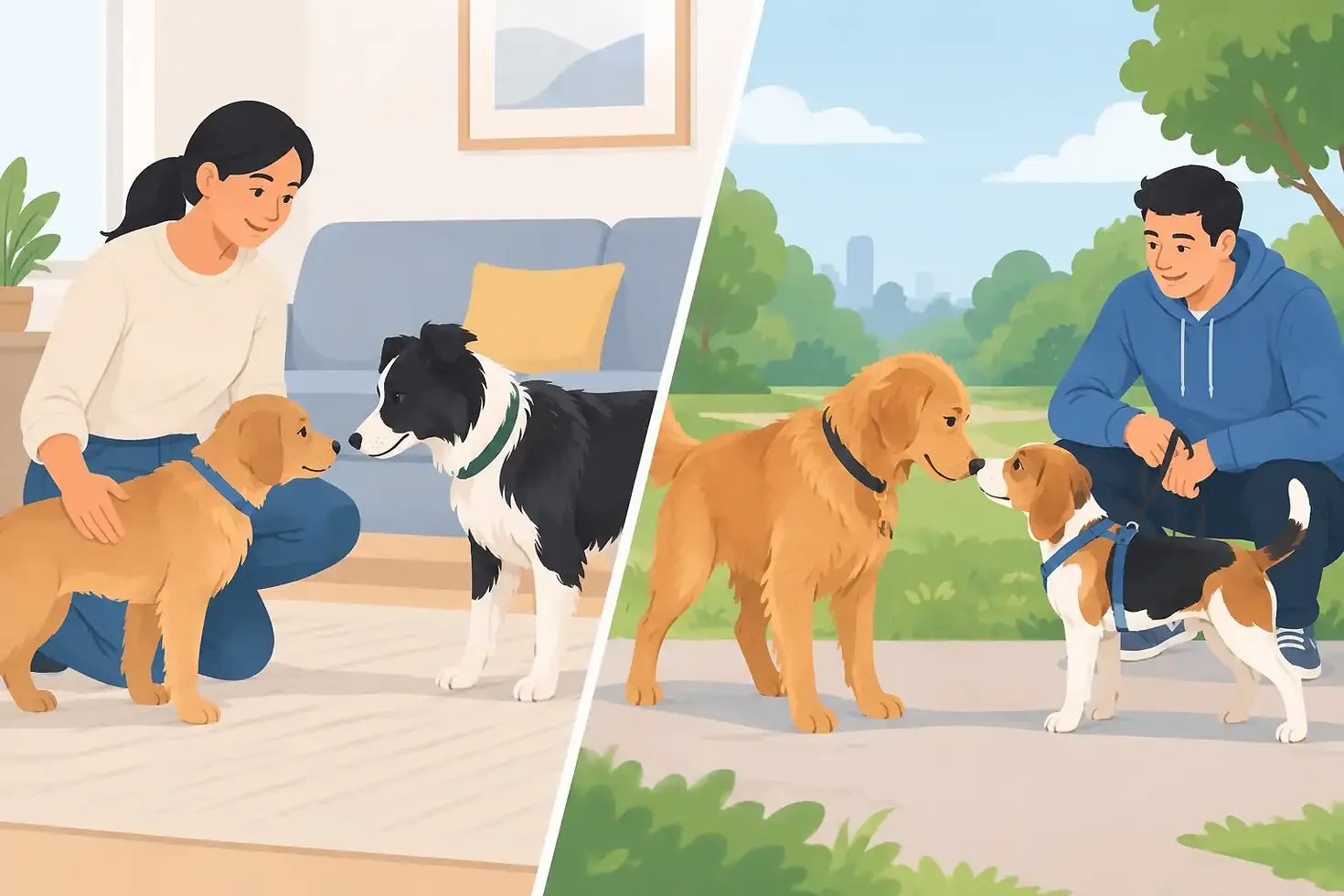
A parallel walk is one of the most effective ways to introduce dogs safely because it lets them observe each other while doing something natural and low-pressure. Begin with both dogs walking in the same direction, far enough apart that neither dog is fixated, barking, or straining at the leash. For some dogs, that may be 10 feet. For others, it may be 30 feet or more.
Walk at an easy pace. Let each dog notice the other, then reward when they look back to their handler or continue walking with a loose leash. There is no prize for getting closer quickly. The dogs are learning that another dog nearby is not a threat and does not require a big reaction.
As both dogs settle, gradually reduce the distance. Walk side by side with a comfortable buffer, then switch sides so neither dog feels trapped between the other dog and a handler. Keep the leashes loose whenever possible. A tight leash can communicate concern and makes normal movement feel restricted.
When both dogs show relaxed interest, allow a brief, curved greeting rather than a direct face-to-face approach. Three seconds of sniffing can be enough. Then cheerfully call the dogs apart and resume walking. Short greetings followed by separation are often safer than allowing two unfamiliar dogs to remain in intense contact until one becomes uncomfortable.
If they repeatedly choose to re-engage with loose bodies and relaxed movement, you can offer another short greeting. If either dog stiffens, turns away, tucks its tail, mounts, pins, body-slams, or becomes overly excited, create distance and return to the walk. A pause is not a failure. It is good handling.
Bringing a New Dog Into the Home
A successful outdoor meeting does not automatically mean dogs are ready for full freedom indoors. Home adds valuable resources: people, furniture, food, toys, doorways, resting places, and territory. Keep the first indoor session structured.
Before entering, take both dogs for a short walk together. Then bring them inside on leash, with one handler per dog if possible. Keep the environment quiet and remove bowls, bones, favorite toys, and anything likely to trigger guarding. Let the dogs move through the shared space briefly, then give them separate areas to decompress.
Baby gates, crates, exercise pens, and closed doors are management tools, not punishments. They allow dogs to see, smell, and hear each other without being forced into constant interaction. Rotate access to rooms, take separate rest breaks, and supervise every shared session until you have a consistent pattern of calm behavior.
Do not leave newly introduced dogs alone together just because their first hour went well. Some dogs are polite during the initial meeting but struggle after excitement builds, when attention shifts to a person, or when one dog wants to rest. Trust is built through many successful, low-pressure interactions.
Manage the Moments That Cause Conflict
Most tension between dogs is not random. It shows up around predictable situations, which gives owners a chance to prevent it. Pay close attention during greetings at the door, meals, treat time, couch access, play, and family attention.
For the first several weeks, feed dogs separately behind a barrier or in separate rooms. Pick up bowls when meals are over. Save chews and special toys for separate downtime until you know there is no guarding concern. Teach each dog to settle on an individual bed or place so both dogs have a clear space to relax.
Play should also be monitored. Healthy play includes breaks, role reversals, loose movement, and dogs choosing to return after separating. Interrupt play if one dog is constantly chasing, pinning, cornering, or ignoring the other dog's attempts to leave. Call the dogs apart, reward calm behavior, and give them a break before deciding whether play should continue.
When to Slow Down or Get Help
Some introductions need hours. Others need days or weeks of gradual exposure. The timeline depends on age, social history, energy level, training, health, and the dogs' ability to recover after excitement. A puppy may be eager but socially rude. An older dog may be tolerant in short sessions but need protected rest and personal space.
Seek professional support if you see repeated hard staring, snapping, fights, resource guarding, escalating leash reactions, or a dog that cannot settle in the other's presence. The right plan may include leash skills, place training, muzzle conditioning, controlled socialization, or individual obedience work before another introduction is attempted.
SafeK9 works with Tampa Bay owners to build the handler skills that make these situations more manageable, from Puppy Pre-K foundations to Behavioral Therapy for more complex concerns. The goal is not to force dogs to tolerate one another. It is to create calm routines, clear communication, and safer choices in everyday life.
A careful introduction is an investment in the relationship you want both dogs to have. Move at the pace of the less comfortable dog, reward calm behavior generously, and let structure do the work that excitement never can.


Comments